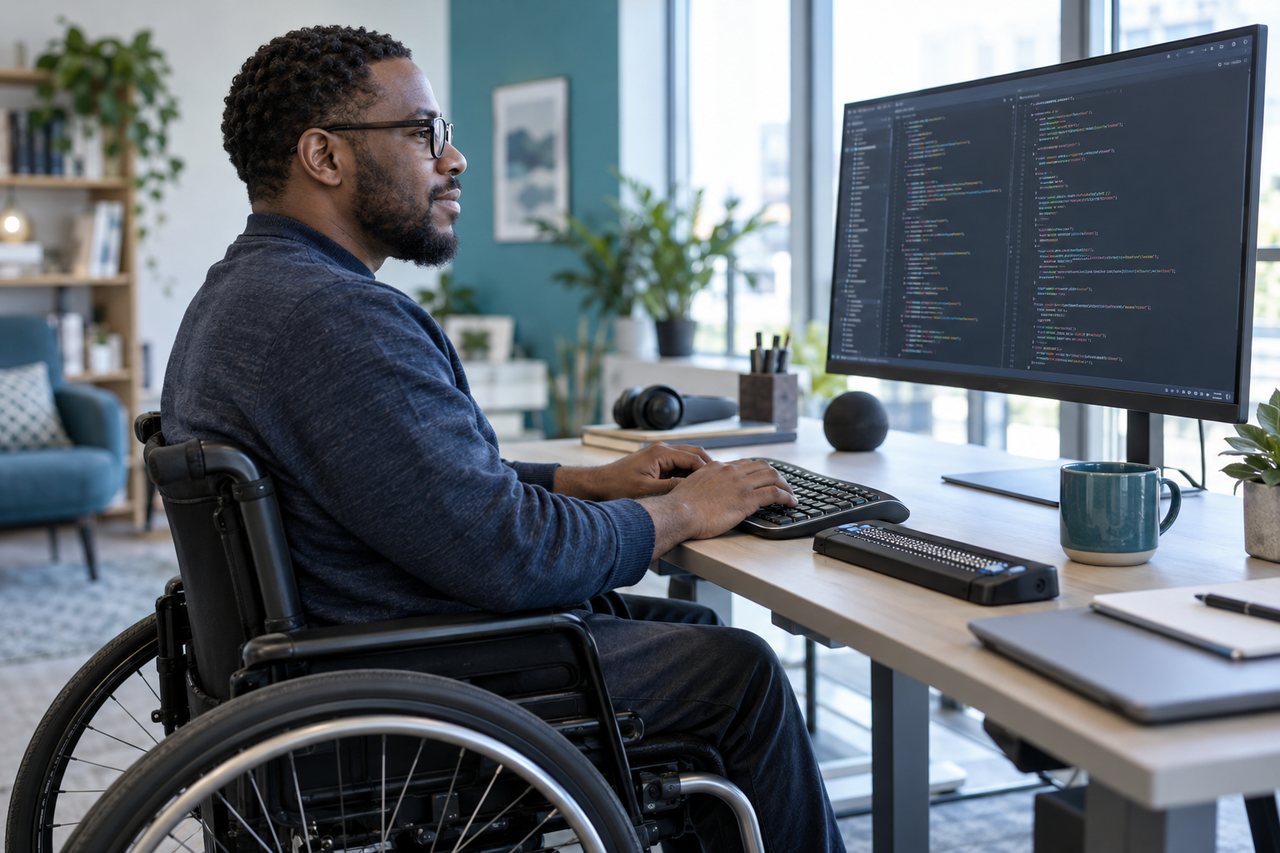
The conversation around disability hiring in tech often centers on obligation—legal requirements, DEI initiatives, the moral imperative to be inclusive. Those things matter. But here's what's actually transformative: AI-powered assistive technology is making it possible for employees with disabilities to perform at levels that were previously impossible.
This isn't about lowered expectations or special accommodations. This is about unlocking human potential that was always there, just waiting for the right tools.
The Real Problem We've Been Missing
For decades, disability hiring has operated under a false constraint: the idea that certain disabilities fundamentally limit what someone can do in technical roles. A developer with severe arthritis couldn't code fast enough. Someone who's blind couldn't navigate complex codebases. An engineer with ADHD couldn't focus on intricate problem-solving. A person with autism couldn't work in collaborative environments.
These assumptions were built on a world with limited tools. In that world, they felt true. But they were never true about human capability—they were true about technology availability.
AI is changing that calculation rapidly. And organizations that understand this are quietly building talent pipelines that competitors haven't even realized exist.
AI Assistive Tools Transforming Tech Roles Today
Consider what's now possible:
For Developers with Motor Disabilities
AI code assistants like GitHub Copilot combined with advanced voice coding tools transform what a developer with arthritis or limited mobility can accomplish. Instead of typing hundreds of lines, they're sketching intent—"create a function that validates email addresses"—and letting AI generate the boilerplate. Voice commands handle navigation. Real-time syntax checking catches errors immediately. The developer's expertise and creativity become the limiting factor, not their hands.
For Employees Who Are Blind or Low Vision
Screen readers have improved dramatically, but AI-powered enhancements make them exponentially more useful. AI can describe complex visual layouts in words. It can read and interpret code structure, highlighting logical relationships that visual inspection would reveal. Accessibility-first development practices, combined with AI tools, mean a blind developer isn't working in a degraded experience—they're working in a different but equally effective modality.
For Neurodivergent Professionals
AI offers something that traditional management rarely does: perfectly consistent, non-judgmental support. Someone with ADHD gets real-time task prioritization and focus assistance. Someone with autism gets predictable communication patterns and automated handling of social overhead—emails drafted, meetings summarized, context preserved. Predictive text and AI writing assistants reduce the cognitive load of context switching.
For Employees with Hearing Disabilities
Real-time captioning and AI-powered transcription are improving so rapidly that the gap between hearing and non-hearing participants in meetings is closing. Meeting notes are auto-generated. Emails are structured for clarity. The information is there, equally accessible.
Why This Matters to Your Organization
Let's be direct: this isn't primarily about being nice to people with disabilities. (Though that's good.) It's about accessing talent that competitors are systematically excluding.
The tech talent shortage is real and expensive. You're competing for a shrinking pool of generalist developers when you should be competing for highly specialized talent that most hiring managers haven't even considered recruiting.
Employees with disabilities often bring distinct advantages that organizations need:
- Problem-solving creativity developed through navigating a world not built for them
- Attention to edge cases and accessibility in product design—catching issues that abled engineers miss
- Different cognitive approaches to technical challenges; diverse thinking drives innovation
- High retention when they find organizations that genuinely support them—far lower turnover than industry average
- Reduced hiring friction in markets where competition is intense
And critically: when you build infrastructure around AI-assisted workflows, you're not just helping employees with disabilities. You're improving how everyone works. Better code assistant adoption. Better documentation. Clearer processes. More accessible communication. These raise the floor for the entire organization.
Building a Disability-Inclusive Hiring Strategy
If your organization wants to actually move on this, it requires three concrete shifts:
1. Rethink Job Requirements
Audit your job descriptions. How many stated requirements are actually essential to the role versus assumptions based on traditional workflows? "Must type 80+ WPM" probably isn't essential if your developers use voice coding and AI tools. "Must have perfect meeting attendance" might not be if you've invested in transcription and async communication.
2. Invest in AI-Enabled Workflows
This isn't optional anymore. Organizations that embrace AI assistants for everyone—code generation, documentation, testing, refactoring—create environments where assistive technology is normalized infrastructure, not special accommodation. That distinction matters psychologically and practically.
3. Partner with Specialists
Don't try to source disability-diverse talent through generic job boards. Work with recruiters who specialize in disability-inclusive hiring. They understand the talent pool, the tools these candidates will need, and how to structure roles for success.
The Future is Now, Just Unevenly Distributed
Some organizations are already building teams with this understanding. They're not doing it primarily for ethical reasons (though ethics matter). They're doing it because they've realized: disabled developers using AI tools aren't less capable than abled developers using AI tools. In some cases, they're more capable because they've had longer to develop sophisticated workarounds.
The playing field isn't being leveled as a favor. It's being leveled by technology. Organizations that recognize this, and structure hiring and work around it, are building more innovative teams, tapping larger talent pools, and actually solving the hiring crisis everyone claims to care about.
At Triangle Workforce, we've seen firsthand how this works. We're proud to partner with organizations serious about disability-inclusive hiring and with job seekers who bring this different perspective to the market. The talent has always been there. The tools to unlock it are finally catching up.
Ready to Build a More Inclusive Team?
We specialize in disability-inclusive hiring and connecting organizations with exceptional talent overlooked by traditional recruiting. Let's talk about how to structure your team for success.
Connect With Us