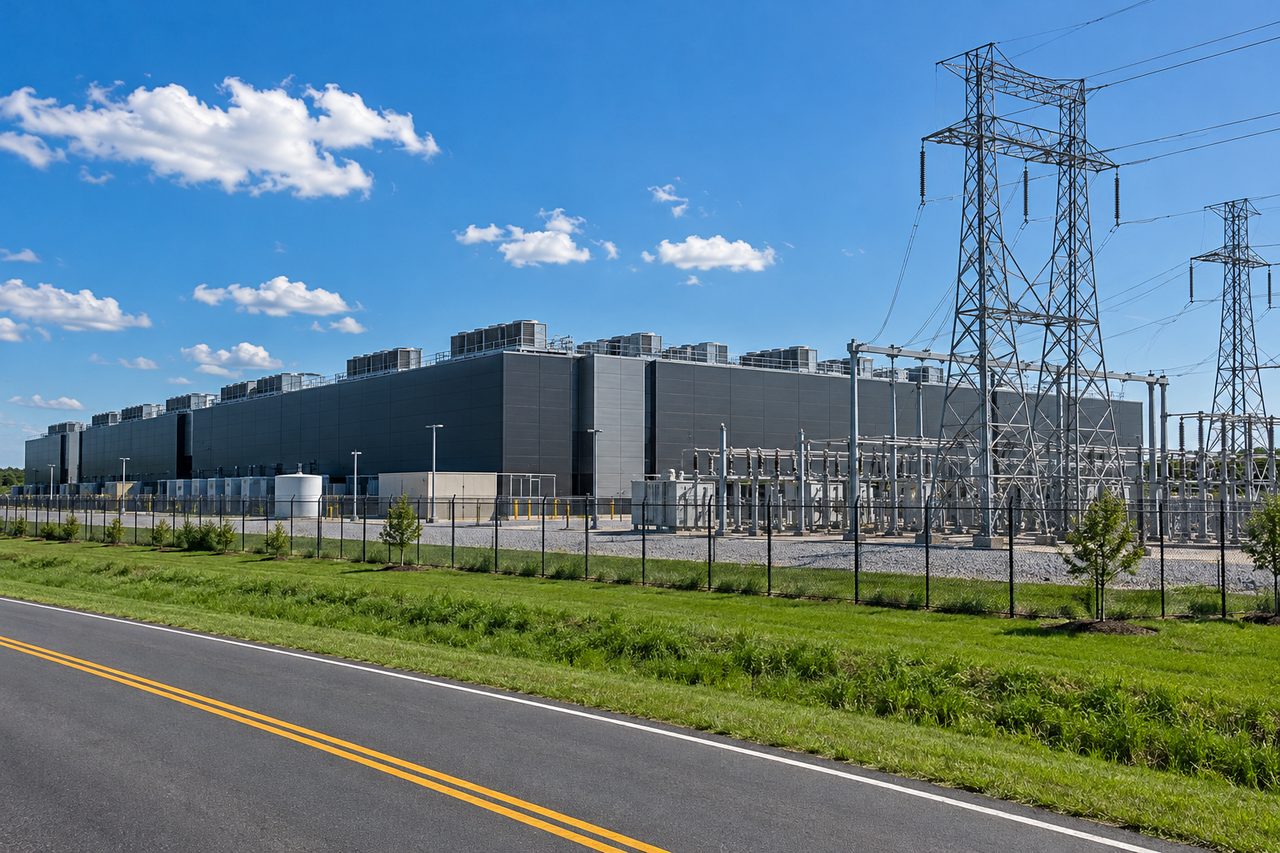
The AI boom has a physical address. It looks like a windowless warehouse the size of several football fields, surrounded by transmission towers, and it is suddenly the most argued-about building in America.
For a decade, states competed to land data centers with tax breaks and cheap power. Now those same states are asking what they bought. Here is where the fight stands, state by state.
Virginia: the tax break meets its audit
Virginia is the data center capital of the world, and its own watchdog just did the math. A December report from the state's Joint Legislative Audit and Review Commission found the industry's sales tax exemption saved data centers $2.73 billion between 2021 and 2024 - 53% of everything Virginia spent on business incentives over a decade. In 2024 alone the exemption cost $1.02 billion, nearly four out of every five incentive dollars the state spent.
The industry's case is real too. The state's economic development office credits data centers with supporting 74,000 jobs and $9.1 billion in GDP a year, and Google pledged another $9 billion of investment in the state through 2026.
But the politics have flipped. Governor Spanberger campaigned on affordability and making data centers pay their own way. This year's General Assembly session saw bills to narrow or end the exemption - most stalled, though a proposal tying incentives to clean energy commitments passed the House of Delegates. Meanwhile, Dominion customers are starting to see the grid costs show up in their power bills.
Georgia: voters fired the referees
If you want to know whether data center anger moves votes, look at last November. Two Democrats, Alicia Johnson and Peter Hubbard, unseated Republican incumbents Tim Echols and Fitz Johnson on the Public Service Commission - the body that sets Georgia Power's rates. It was the first time in roughly twenty years Democrats won a non-federal statewide race in Georgia, and rising power bills tied to data center growth were the issue that did it.
The legislature got the message. At least seven bills are pending this session: one would keep data center power costs out of residential rates, two would sunset or end the sales tax break (the sponsor of one is the Senate Rules chairman, a Republican), and one - House Bill 1012 - would ban new data center construction outright until March 2027. Governor Kemp vetoed a full repeal of the tax break back in 2024. That was before the election.
One more number from the state's own audit: the exemption cost Georgia $474 million last fiscal year, while data centers produced 8,505 construction jobs and 1,641 permanent operations jobs. That split - thousands to build, hundreds to run - is the whole argument in two numbers.
Texas: the kill switch
Texas still wants the business. It just wants the right to pull the plug. Senate Bill 6, signed in June 2025, requires new large power users of 75 megawatts or more to accept curtailment during grid emergencies and install shutoff equipment as a condition of connecting to the grid. It also charges a $100,000 interconnection study fee and forces companies to disclose duplicate connection requests, a fix for the "phantom loads" clogging up forecasts.
The context is Winter Storm Uri in 2021, when millions of homes froze while industrial loads hummed along. ERCOT now expects large loads on its grid to grow from 87 gigawatts today to 138 by 2030, and nobody in Austin wants to explain a second freeze.
Ohio: pay for what you reserved
Ohio's regulators approved a new tariff for AEP Ohio in 2025 that works like a restaurant charging for the table, not the meal. Large new data centers must pay for at least 85% of the power they contract for, whether they use it or not, under twelve-year commitments with exit fees and proof they are financially good for it. Amazon, Google, Microsoft and Meta fought the plan. They lost.
The model is spreading. Indiana Michigan Power won approval of a similar settlement requiring 80% minimum monthly payments, after forecasting data centers could push its peak demand up 150% by 2030.
Indiana: the giveaway hangover
Indiana landed roughly $15 billion in announced Big Tech campuses - Amazon's $11 billion site in New Carlisle, a $2 billion Google project in Fort Wayne, $1 billion from Microsoft in LaPorte, $800 million from Meta. Then the bills arrived. A state fiscal analysis estimates the tax breaks could leave Indiana $2.2 billion short, and the Citizens Action Coalition, a consumer group, is pressing for a construction moratorium.
State Rep. Ed Soliday, a Republican who carried a bill making tech firms cover most new power costs, put the sentiment plainly: "Grandma down the street shouldn't have to pay for your dreams."
Arizona: water is the hard no
In the desert, the argument is simpler. Tucson's city council voted 7-0 in August 2025 to kill Project Blue, an Amazon-linked data center, after weeks of public pressure - then moved to regulate large water users. In December, Chandler's council unanimously rejected a 400,000-square-foot project whose developer had sought the ability to use more than 100 million gallons of water a year. Power can be negotiated. Water, in Arizona, cannot.
North Carolina: our turn is on the desk
North Carolina has mostly watched this from the sidelines. We have hosted big server farms for years - Apple's campus in Maiden is the classic example - without a hyperscale land rush.
That may not last, and Raleigh knows it. Senate Bill 730, the Ratepayer Protection Act, passed the state Senate in May 2025 and passed the House 69-44 this June. It now sits one concurrence vote away from the governor's desk. The House version requires site assessments for noise and water impacts near homes and schools and mandates closed-loop cooling for facilities drawing 100 megawatts or more. Whatever you think of the policy, North Carolina is about to set its own rules.
What this means for hiring
First, an honest read: a finished data center is not a jobs engine. Remember Georgia's audit - 1,641 permanent operations jobs statewide. The real employment story is the build-out: construction executives, electrical and power engineers, commissioning managers, controls technicians. Those searches are already hard, and every state above is competing for the same people. The twelve-year commitments coming out of places like Ohio mean the projects that do break ground are the serious ones.
Second, the power fight is an AI story. The same spending wave straining the grid is what keeps ML infrastructure, data engineering, and platform talent scarce. When a hyperscaler commits to a state, the talent market around the site tightens before the building opens.
For North Carolina employers specifically: if Senate Bill 730 becomes law, future projects here arrive with public scrutiny baked in. The companies that plan the workforce story early - who gets hired, from where, doing what - will have an easier time at the zoning hearing than the ones that show up with a rendering and a promise.
The era of "land it first, ask questions later" is over. The states that made data centers a growth strategy are now reading the fine print. If you hire anywhere near this industry, so should you.
Sources
- WRIC: Data centers save $2.7 billion through tax exemptions, more than half of Virginia's incentive spending (JLARC)
- Virginia Business: Virginia data center tax reform passes House as other sales tax bills stall
- Georgia Public Broadcasting: Resistance to data centers fuels flood of Georgia bills targeting the industry
- Reuters: Georgia voters oust GOP utility commissioners over rising electricity rates
- Utility Dive: Texas law gives grid operator power to disconnect data centers during crisis
- Renewable Energy World: Ohio utility regulators approve AEP's contested data center tariff proposal
- Business Insider: Indiana residents don't want to pay for Big Tech's energy bill
- WFYI: Data center tax breaks could leave Indiana $2.2 billion short
- KVOA: Tucson City Council unanimously rejects Project Blue
- FOX 10 Phoenix: Chandler City Council unanimously rejects proposed data center
- North Carolina General Assembly: Senate Bill 730, Ratepayer Protection Act